This upcoming Sunday, as the conciliar church celebrates the Judaized Solemnity of Our Lord Jesus Christ, King of the Universe, sincere but naïve persons, most of whom simply want to believe and live as Catholics, will be fed a series of aberrant ideas that obscure the Church’s true doctrine on the Kingship of Christ.
Among them:
– The God of revelation has always been understood as the King of all creation, and it is due to our faith in the Divinity of Jesus that we dare to exclaim, Christ is King!
– The Kingdom of Christ is a spiritual rather than an earthly reality; as He said to Pilate, My Kingdom is not of this world.
– Our Lord’s reign does not entail the exercise of power over things political.
– It is primarily up to us Christians to give witness to Christ’s Kingship by living lives that testify to His sovereignty over our individual hearts, minds, and souls.
The truth, however, is that when we acknowledge that Christ is King, we do so not simply because the Son, being the second Person of the Blessed Trinity, has always been King of all creation, but rather because Kingly power has been given to Jesus by His Father (see Matthew 28:16-20).
His Sovereignty, therefore, is an acquired right, purchased as it were by His meritorious Sacrifice, i.e., Christ is King as man in the strict and proper sense. (cf Pope Pius XI, Quas Primas)
As for His Kingdom, it most certainly is a present reality in the here and now; the Catholic Church is the kingdom of Christ on earth. (ibid.)
What’s more, the dominion of Christ the King extends to every individual, every family, every society, and every State, not only Catholic nations; for all men, whether collectively or individually, are under the dominion of Christ. (ibid.)
This being so, there can be no doubt that Our Lord’s Kingship is exercised over things political such that not only private individuals but also rulers and princes are bound to give public honor and obedience to Christ. (ibid.)
While it is true that one is called to live a life that gives witness to Our Lord’s Sovereignty over the heart, the mind, and the soul, apart from the social dimension of Christ’s Kingship described above, society will never receive the great blessings of real liberty, well-ordered discipline, peace and harmony. (ibid.)
There is as yet one more, unfortunately common, doctrinal aberration to mention, namely, the notion that the Cross is the throne of Christ the King, as if He presently reigns from the gibbet of His execution.
Although this proposition is in a certain sense defensible (with no small effort and a great deal of context, as we shall discuss), I would suggest that it can be (and has been) invoked in a way that serves more to mislead than to edify, even if only inadvertently. More regrettable still is the fact that the Cross as throne idea is sometimes preached by well meaning priests, at times, even in the context of the ancient Latin Mass for the Feast of Christ the King.
Consider the words of Benedict XVI, alleged to be the most “traditional” of the post-conciliar claimants to the papacy:
The throne of this King whom we worship today is the Cross, and his triumph is the victory of Love, an almighty love that from the Cross pours out his gifts upon humanity of all times and all places. (Letter to Card. Andrea Cordero Lanza di Montezemolo, 25 Nov. 2006)
In searching for similar texts in the traditional papal magisterium (if you’ll excuse the redundancy), very little is to be found that so explicitly states that the Cross is the throne of Christ the King today.
Consider, however, the following from the Encyclical of Pope Pius XII, Mystici Corporis:
Who finally has been so exalted as He, who as “the one mediator of God and men” has in a most wonderful manner linked earth to heaven, who, raised on the Cross as on a throne of mercy, has drawn all things to Himself.
The Holy Father speaks in a similar manner in the Encyclical, Summi Pontificatus:
May His grace stir in the “troubled heart” of the wanderers a homesickness for things eternal, a homesickness that impels them to return to Him, Who from His sorrowful throne of the Cross thirsts for their souls.
It must be said that neither Pius XII, nor any of his predecessors of whom I am aware, were plainly suggesting that Christ the King presently reigns from the Cross, rather, the above citations seem best understood in reference to the historical event of the Crucifixion. In other words, it was on Calvary that Our Lord made good on His promise, If I be lifted up from the earth, I will draw all things to myself. (John 12:32) Likewise, was it there that Our Lord spoke these blessed words: I thirst. (John 19:28)
Yes, Our Lord is still lifted up from the earth, and even now He thirsts for souls, and yet in a different way: Having ascended into Heaven, He continually offers Himself as He intercedes for us at the right time hand of the Father Almighty.
At the same time, it can be said that the Cross, as it stood on Calvary, was truly as a throne insofar as it was thereupon that the divine nature of Christ, true God, the King of all creation, chose to pour out His mercy upon mankind.
Pope Pius XI, however, makes an important distinction:
We cannot but see that the title and the power of King belongs to Christ as man in the strict and proper sense too. For it is only as man that he may be said to have received from the Father “power and glory and a kingdom.” (cf Pope Pius XI, Quas Primas)
At this, let us ponder from whence Christ the King, as man in the strict and proper sense, reigns.
Again, we turn to Pope Pius XII. Quoting St. Thomas Aquinas, the Holy Father teaches:
“For it was through His triumph on the Cross,” according to the teaching of the Angelic and Common Doctor, “that He won power and dominion over the gentiles.” (cf Mystici Corporis)
As previously mentioned, Pope Pius XI stated that “Christ is our King by acquired right” (cf Quas Primas). In this, the Holy Father is echoing his venerable predecessor Pope Leo XIII:
Christ reigns not only by natural right as the Son of God, but also by a right that He has acquired. For He it was who snatched us “from the power of darkness” (Col 1:13), and “gave Himself for the redemption of all” (1 Tim 2:6) … St. Augustine’s words are therefore to the point when he says: “You ask what price He paid? See what He gave and you will understand how much He paid. The price was the blood of Christ. What could cost so much but the whole world, and all its people? The great price He paid was paid for all.” (Pope Leo XIII, Annum Sacrum, 1899)
And how was His Kingship acquired?
It was earned by His Cross, the instrument of His triumph.
Pope Pius XII further indicates that the Cross is more properly considered the instrument of Christ’s conquest as opposed to the place from which reigns:
For that which our Lord began when hanging on the Cross, He continues unceasingly amid the joys of heaven: “Our Head,” says St. Augustine, “intercedes for us: some members He is receiving, others He is chastising, others cleansing, others consoling, others creating, others calling, others recalling, others correcting, others renewing.” (cf Mystici Corporis)
Elsewhere, the Holy Father, Pius XII, speaks on the matter more explicitly still:
Christ reigns upon His heavenly throne. (Mediator Dei)
Not one of these traditional citations are perplexing in the least insofar as Christ the King is risen indeed: He is risen in glory! He is risen triumphant!
It must also be noted that Our Lord reigns through His Mystical Body, the Church, most notably through His Vicar on earth, the pope.
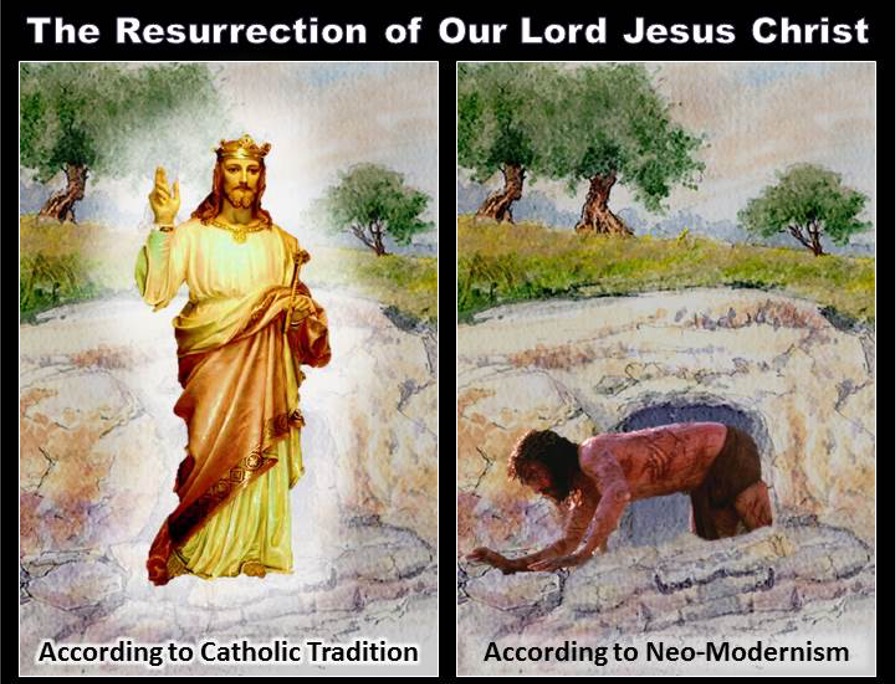
The conciliar mindset, by contrast – wherein the leaders of nations are no longer considered bound to uphold their “public duty of reverence and obedience to the rule of Christ” (cf Quas Primas) – is summed up well in the following insult leveled at “traditionalists” by Jorge Bergoglio (stage name, Francis):
This group of Christians in their hearts do not believe in the Risen Lord and want to make theirs a more majestic resurrection than that of the real one. These are the triumphalist Christians.
Men like Bergoglio and his conciliar confreres cannot bear to acknowledge the triumph of Christ the King, He who received from His Father power and glory and a kingdom, rather, they much prefer to preach a “distorted and diminished Christ” (cf Pius X, Nostre Charge Apostolique) one who even now submits to being bloodied and beaten by the elite rulers of this world.
In other words, theirs is a king in name only, a paper sovereign who requires nothing of his subjects, a law-giver who dispenses false mercy devoid of any judgment.
Therein lies the deceptiveness inherent to the notion that the Cross, even now, is the throne of Christ the King. Missing from such a treatment is a truth no less central to our Catholic faith than the Resurrection.
In the General Audience of 18 September 2002, for example, John Paul II declared: “The Lord reigns from the Cross.”
In that same audience, he went on to speak of “Christ who reigns from the height of the Cross – a throne of love and not of dominion.”
In so doing, he demonstrated with great clarity why the Cross as throne is such an insidious proposition, namely, it creates a false dichotomy between the love of Christ the Eternal High Priest as shown forth in perfection on the Cross, and the dominion of Christ the King, the Risen One to whom all power, glory, and authority has been given.
[If you found this post helpful, please consider sharing it with your Novus Ordo friends and family members who are likely to be misled on Sunday.]