AI is all the talk in Catholic circles these days thanks to Leo’s 42,000-word tome, Magnifica Humanitas. At present, I’m still attempting to digest that voluminous text and will have more to say about it soon enough.
For now, however, I’d like to address an issue that isn’t getting nearly the attention it deserves, namely, the way in which certain magnificent humans are surreptitiously abusing AI even as they publicly cloak themselves under the mantle of Catholic tradition.
Mid-summer of last year, a friend called my attention to a very well-known “celebrity cleric” who, evidently, has been using AI to assist in his writing.
No crime there. AI can be a very useful research tool. I, and probably most other Catholic writers, use it often to find relevant citations, books, articles, etc. It does, however, have its limitations. For example, AI tools often provide direct quotes, allegedly direct, where none actually exist. This happens at times even when the query specifies “direct quotes only.”
It’s entirely necessary, therefore, for those who use AI for research purposes to confirm every single citation that it provides.
The problem in the above-mentioned case is that the clerical writer was weaving dubious quotes from Saints and popes into his articles. Upon a not-very-extensive review, my friend discovered many such citations in his writing, i.e., “quotes” that simply don’t exist. The conclusion we drew is that he likely has no idea that AI can be so misleading. So, what to do…
I reached out to him, kindly pointing out examples of the AI manufactured “quotes” that were discovered in his articles. I let him know that my intention in writing was not to criticize – after all, it’s a mistake anyone can make – but rather to enable him to edit his articles where necessary and to avoid this issue moving forward.
He never responded, which, if he actually received my message, although rude, is no big deal.
What is truly troubling, however, is that the fake quotes remained on his website for months afterward. As of this writing, he has deleted at least one of the fake quotes (which suggests that he actually received my cautionary note) but, unfortunately, others still remain.
Though I’m no fan of this tradservative cleric (nor vice versa), unless I have good reason to believe otherwise, I’m pleased to assume that he acted in good faith, which is much more than I can say for the person you’re about to meet. But first…
QUESTION: How can we know if a poem, a song, an article, an entire book, etc. is actually the work of the person claiming authorship, or whether it is perhaps a work largely generated by AI?
ANSWER: Ask AI, of course!
Before I go into more detail, let’s consider a more crucial question:
Does it really matter?
I suppose one might argue that a painting, although generated by AI, can still be beautiful, even if not nearly as inspiring as one created by the hand of an artist. One might even say something similar about a poem or a song, etc.
What all can presumably agree upon is that it is utterly fraudulent and downright sinful for an individual to mispresent as entirely original, articles that were actually created, either entirely or in substantial part, by AI. In the case of a person who postures as a so-called “traditional Catholic” writer, the gravity of both the fraud and the sin is exponentially greater.
This brings us to the topic at hand: The presence of AI fraud in Catholic media.
I recently had good reason (which I will share momentarily) to believe that an increasingly prominent and prolific “traditional Catholic” writer has been passing off, as his own original work, articles that were very likely generated in large measure by AI.
Fortunately, there are reliable AI tools that can estimate, with a high degree of accuracy, whether and to what extent a given article may be AI generated. The way these tools work is by detecting statistical patterns that commonly exist in such text, i.e., AI is capable of recognizing its own handy work.
WARNING: There are “free” (and fraudulent) AI tools of this nature available online that are designed to lure users into a paid subscription. The way the scam works is that the app will flag practically any article (including those that you know for certain are original) as most likely AI generated.
The catch is that one must then pay in order to view detailed results, which are themselves entirely bogus.
Knowing this, I obtained one of the most highly rated AI detection tools available in order to scan a variety of articles written by a cross section of prominent Catholic writers, just to see what we might learn.
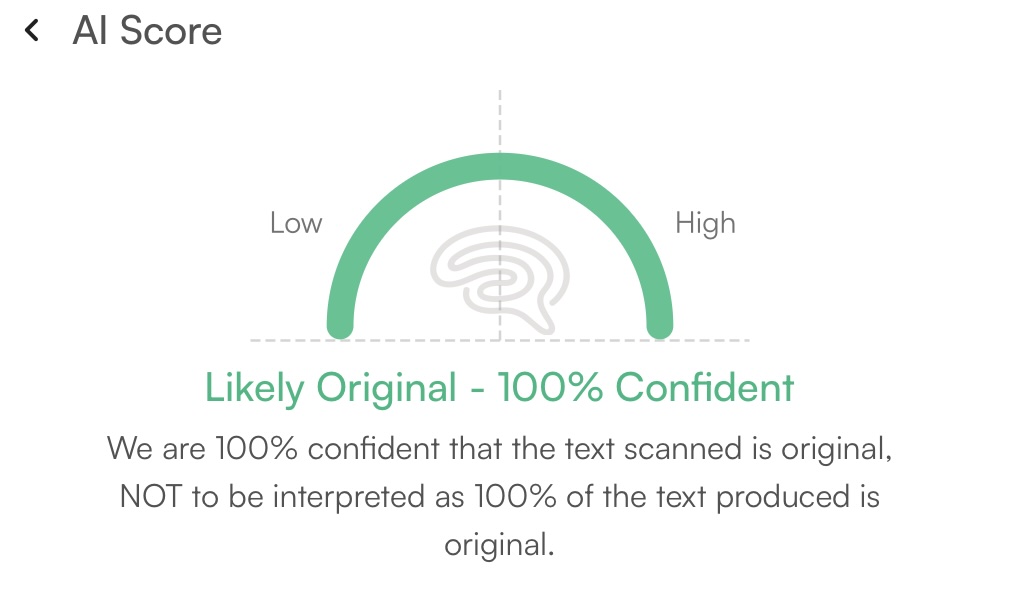
To begin, as a test case, I scanned one of my own recent posts. The result was as expected.
Next, I scanned a well-known writer from a popular Catholic website. Same result. Several more writers from similar websites. Same results. (See image)
Before we continue, let’s talk about what these scan results mean.
If a scanned text yields a result that says: “Likely AI – 68% Confident,” this does not mean that 68% of the text is AI-generated, nor that a human being is responsible for 42% of the content. What it does mean is that the tool estimates, based on its evaluation of known AI patterns and characteristics, that there’s a 68% probability that the document was generated primarily, or largely, by AI.
Is it as conclusive as the kind of DNA evidence that would result in a conviction in a court of law?
Certainly not, and yet it does provide a significant indication of the true nature of a given text, the higher the percentage of confidence in the yielded result, the more likely it is to be accurate. Add to this, if possible, other supporting indications that may be available on a personal level, and the likelihood of accuracy increases considerably.
With this explanation out of the way…
It just dawned on me, quite literally as I write this article: What if I scan a recent article from the aforementioned celebrity cleric?
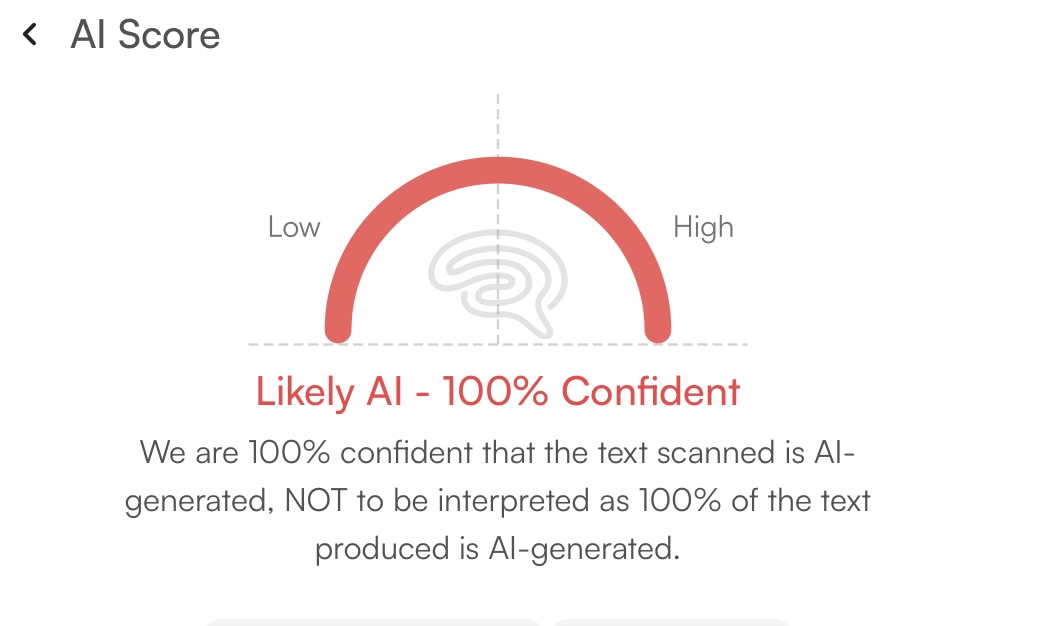
To my genuine shock, the result was the exact opposite of the “100% likely original” results obtained when I scanned articles attributed to the aforementioned Catholic writers.
I then scanned yet another of the cleric’s articles. Same result. And then a third. Same result: “Likely AI – 100% Confident.”
To be extra cautious, I then removed from the text all quotations, leaving only the cleric’s (supposed) very own words and ideas. Same result.
So much for the presumption of good will. (See photo)
At this, let’s turn our attention at last to the person that sent me down this dark road in the first place, a man with whom every reader of this space is most likely familiar. I’m not going to name him, not just yet anyway, for reasons I’ll explain later.
For now, for the sake of this article, I propose that we give him an alias, a pen name if you will: Let’s call him Chuck Jennings.
Some time ago, a friend and fellow writer discovered that Chuck had been publishing, in his own name, articles that appear very likely to be the product of AI in substantial measure. In fraternal charity, as an expression of the Spiritual gift of counsel, he told Chuck to stop carrying on this dishonest activity, or at the very least, to disclose to readers what he’s been doing.
Now, put yourself in Chuck’s shoes. What would you do?
For my part, if a fellow writer, acting in good conscience, counseled me to cease publishing AI generated articles on this blog, I’d passionately deny the mere implication, letting him know in no uncertain terms that he is badly mistaken. Good, bad, or otherwise, my work is entirely my own!
Chuck, however, didn’t do that. There was no protest, no denial, no insistence that the very suggestion that his articles are not entirely his own is preposterous. In fact, he tacitly acknowledged what he was suspected of doing.
So, what is Chuck Jennings up to today? Is he continuing to deceive a growing list of sincere readers, an unknown number of whom are providing financial support for his (and his AI tool’s) efforts, or has he chosen to clean up his act?
The scan result of Chuck’s most recent article, a short novel in its own right, came back: “Likely AI – 96% Confident.” His second most recent article: “Likely AI – 78% Confident.”
To be clear, we’re not talking about a handful of dubious quotes inserted in an otherwise original work, in fact, these articles feature very few quotes at all, which is odd for articles that amount to a critique of the conciliar church’s misdeeds.
For example, take a look at posts on akaCatholic (or any other such site), especially articles that are offered in response to documents like Amoris Laetitia, Traditionis Custodes, Fiducia Supplicans, or any of the sixteen Council documents. What you’ll typically find are articles that feature numerous (even to the point of annoying) block quotes from the captains of the counterfeit church, as well as citations (often lengthy) from pre-conciliar sources.
Articles comprised in large measure of AI generated synopses, by contrast, look very different.
The issue in this case isn’t so much the use of an AI tool, per se, it’s the fakery, the dishonesty, the deception, the idea that AI content is almost assuredly being misrepresented (and in some sense, sold) as one’s own proprietary independent analysis.
If all that has been said thus far isn’t disturbing enough, the potential fraud runs so deep in Chuck’s case that even a scan of the “About” page on his website came back: “Likely AI – 100% Confident.”
So, who is this scoundrel?
As I said, I may end up naming him at some point, but my hope is that it won’t be necessary. Readers of this space aren’t exactly dull. Some of you may have had your suspicions about this very person even before reading this post, others likely have a good idea of who he is, others still will do their own homework (which I encourage) and quickly figure it out.
This being so, perhaps Chuck will see the handwriting on the wall (not AI, btw) and muster up the integrity to reveal himself and to apologize to the people he has been deceiving, not only those who gave him financial support, but also those reputable Catholic writers and publishers who embraced him (clerics included), shared his work, lent him credibility, quoted him and encouraged him.
As for the celebrity cleric? I’m going to make yet another attempt to give him a chance to do the honorable thing. Not likely, I know, but we’ll see where that goes…
In the meantime, keep your eyes opened wide and be on alert, that you don’t find yourself deceived by an AI middleman posing as a Catholic content creator.